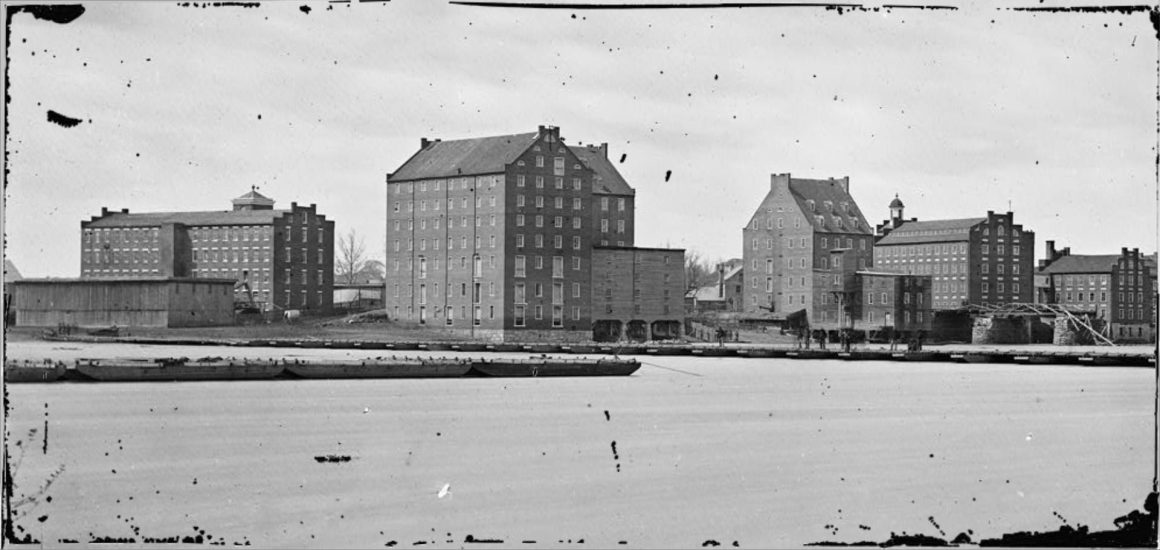
Here at Ancarrow’s Landing was the site of the Manchester Docks. As stated at the courthouse stop, because a variety of early American naval vessels and other ships were built here and at the nearby shipyard across the river at Rockett’s Landing, the streets of Manchester were named after American Revolution and War of 1812 naval heroes. Hull Street in particular was named after commander Isaac Hull of the USS Constitution, the frigate known as “Old Ironsides.”
Beginning with the arrival of the first Africans in 1619, Virginia was a leading port of entry for vessels engaged in both the international and domestic slave trades. From 1690 to 1770, over one hundred-thousand Africans were imported into Virginia. With the founding of Richmond in 1737 and Manchester in 1769, imports of enslaved Africans to the Upper James River increased dramatically. From 1761 to 1774, approximately 3,400 Africans were imported into Richmond and the surrounding Upper James River area alone. Many of these men, women, and children were unloaded from the overloaded, cramped, and filthy decks of slave ships here in Manchester before being chained together in a slave coffle and forced marched across the James River to be imprisoned in Shockoe Bottom while awaiting sale. These enslaved human beings were typically marched at night to avoid being seen by the local white residents.
Virginia banned the trans-Atlantic slave trade in 1778 and the United States did so in 1808, but the domestic slave trade continued to flourish. A number of businesses, auction houses, hotels, and other establishments were located in both Richmond and Manchester that catered to the domestic slave trade. By the 1850s, Richmond had the third largest black population of any urban area in the south, as well as the second largest slave market. It is estimated that receipts from the sale of enslaved Africans in 1857 totaled $3.5 million dollars. In 1860, a total of fifteen businesses, nineteen auctioneers and auction houses, as well as dozens of business related establishments operated in Richmond’s Shockoe Bottom. The most notorious of these was Lumpkin’s Slave Jail, known to the enslaved as ‘the Devil’s Half Acre.’
Seeking to understand and acknowledge the human pain endured by those enslaved by Robert Lumpkin at his business, in 2001 the city of Richmond partnered with Liverpool England to create the Reconciliation Triangle Project, connecting the two cities formerly connected with the slave trade with the African nation of Benin, point of embarkation for millions of enslaved people. The project sought to ‘preserve heritage and historical fact and to promote acknowledgement of African descended people who were unwilling and unwitting victims of the ‘Peculiar Institution’ of human bondage.’ Soon after, Richmond established the Richmond Slave Trail Commission, to honor the memory of those who were brought to America against their will, as well as to preserve and interpret the history of the site, and to promote community healing. In 2011, the commission established the interpretive signs seen along the trail, which proceeds from Ancarrow’s Landing to Mayo’s Bridge, then crosses the river to Shockoe Bottom before proceeding past the site of Lumpkin’s jail and the African Burial Ground, and terminating at the First African Baptist Church on Broad Street. The signs provide the experiences of many enslaved individuals from first-hand accounts, as well as images including drawings and items related to the slave trade.
Robert Lumpkin was the most infamous slave dealer in Richmond. From the 1840s until the end of the Civil War in 1865, Lumpkin operated a property that purchased, temporarily held, and then sold enslaved men, women, and children to plantation owners and domestic slave traders from elsewhere in the south. Lumpkin’s property was an expansive complex, consisting of a jail, auction house, and lodging facilities for his wealthy out-of-state clientele. By the dawn of emancipation, Lumpkin had developed a reputation as an exceptionally cruel businessman. However, he died shortly after the end of the Civil War, and his property passed to his widow, Mary an African American woman who had formerly been Lumpkin’s slave. In 1867, Mary Lumpkin leased the property to establish a school for freed slaves. This school later became known as Richmond Theological Seminary before changing its name Virginia Union University and relocating to its current location in north Richmond.
In 2006, the Richmond Slave Trail Commission commissioned an archeological excavation of the former site of Lumpkin’s jail. The excavation determined the former site of the jail, as well as other structures that had been built prior to Lumpkin’s acquisition of the property. The archeologists used a variety of primary documents to understand and document the lives of the enslaved people held there, including memoirs by an escaped slave named Anthony Burns, and an account of the creation of the Seminary by a freedman named Charles Corey. Their work allowed the Association for the Conservation of Old Richmond Neighborhoods to conserve and relocate the Emily Winfree Cottage to its current site at the former slave jail. Winfree had been enslaved by Lumpkin before the war, and later raised her children as freemen during reconstruction. This work shows how the lives of blacks such as Winfree and whites such as the Lumpkin’s were always intertwined and never separate.
 ManchesterRVA