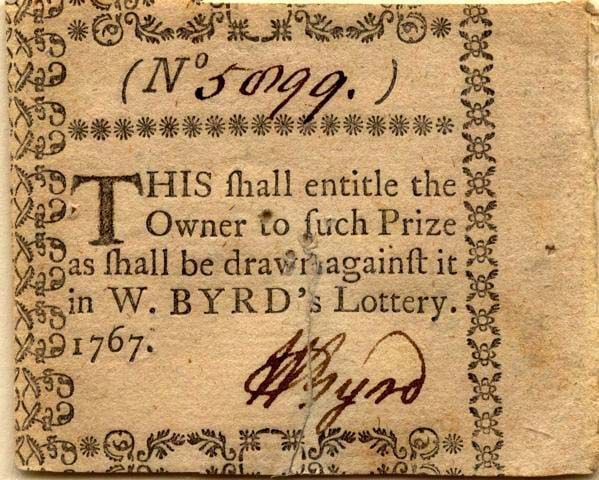
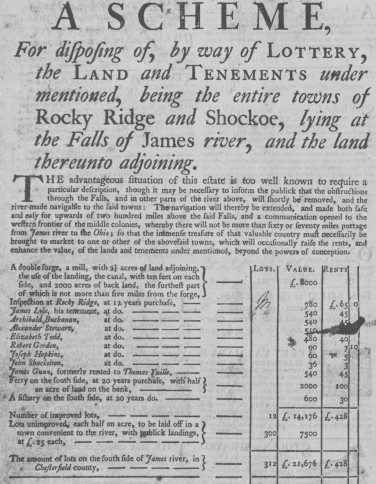
Throughout the Colonial Era, the area south of the James River was known as ‘Rocky Ridge.’ Much of the area was owned by Willian Byrd II and his son. In 1767, the Virginia Gazette announced ‘A Scheme for disposing, by way of lottery, the land and tenements under mentioned, being the entire towns of Rocky Ridge and Shockoe, lying at the Falls of the James River, and the land thereunto adjoining.’
To attract subscribers to the lottery, the article claimed ‘The advantageous situation of this estate is too well known to require a particular description, [though the river] will be made navigable to the said towns.’ Further, the article appealed to merchants and others interested in bypassing the falls of the James River, a rocky seven-mile zone where the river descends 100 feet and navigation inland becomes impossible to ocean-going vessels. It promised that a canal would soon be built on the south side of the James that would extend for ‘upwards of two hundred miles above the said falls, and a communication opened to the westward frontier…. from the James River to the Ohio…so that the immense treasure of that valuable country must soon be brought to market… which will raise the rents, enhance the value of the land and tenements under mentioned, beyond the powers of conception.’
The article continued by listing the variety of businesses, warehouses, and inspection stations in business in the Rocky Ridge area.
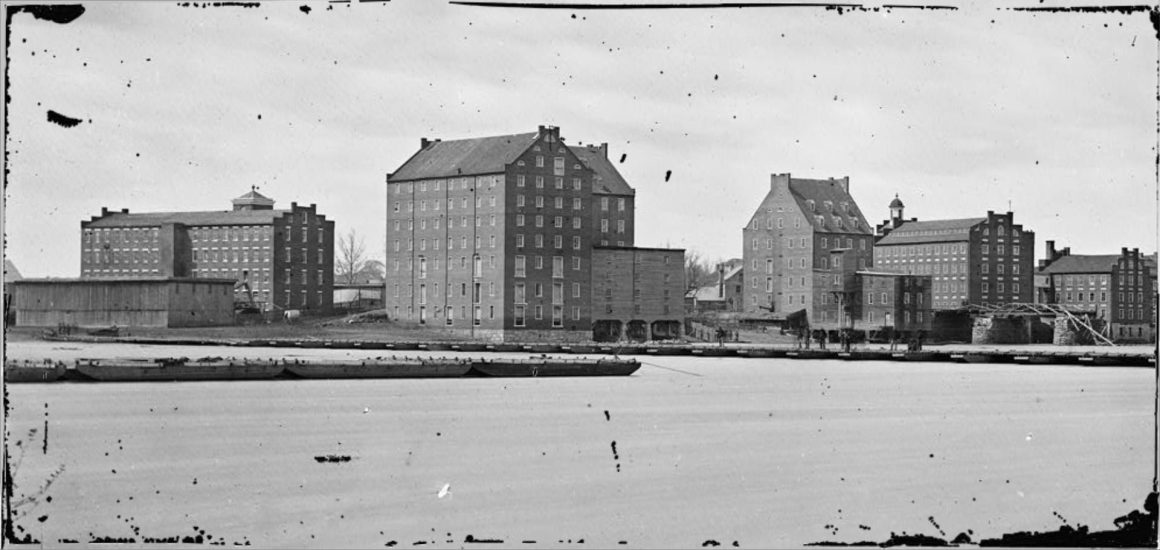
In 1771, the James River overran its banks and flooded both Manchester and Richmond. The flood was devastating to the residents and businesses. A number of merchandisers had opened shops and warehouses by that time, including a dry goods store, tobacco shops, and a tavern or hostelry. Many of the buildings on low lying lots sold just a few years before were destroyed.
 ManchesterRVA